

What Workforce Capacity is Hiding Inside Your Microsoft 365 Environment?
Organizations are spending billions on AI, automation platforms, agents, copilots, and digital transformation initiatives.
Yet one question is rarely asked first:
How much work can the environment you already own absorb before another dollar is spent?
That question sits at the center of our latest WFDI Show & Tell.
Most Microsoft 365 conversations begin with technology.
- More licenses.
- More automation.
- More AI.
- More tools.
Our research suggests a different starting point.
Work first. Capacity second. Technology third.
The surprising reality is that many organizations are carrying a significant amount of recoverable work capacity before introducing additional software, advanced AI services, or new headcount. The opportunity is often hidden inside information movement, coordination, reporting, approvals, documentation, and status management.
In other words, the largest opportunity may not be a technology problem at all.
It may be a work problem.
Point #1: The $0 Capacity Recovery Story
Most executives immediately focus on what to buy next.
The more interesting question is:
What work can the existing environment absorb today?
Microsoft 365 already contains collaboration, information management, workflow, reporting, and coordination capabilities that are often dramatically underutilized.
The challenge is not capability availability.
The challenge is understanding where work is being manufactured and how existing capabilities can absorb that demand.
When organizations approach Microsoft 365 through a work lens rather than a feature lens, the conversation changes completely.
The question stops being:
“What technology should we add?”
And becomes:
“What work should disappear?”
Point #2: The 5% of Roles That May Govern 50% of Capacity
Some roles perform work.
Other roles govern work.
Those are not the same thing.
A project manager, resource manager, operations leader, PMO director, contract leader, executive assistant, or sales operations manager may represent a relatively small portion of organizational headcount.
Yet those roles often influence the flow of information and decisions across dozens, hundreds, or even thousands of people.
Improving the efficiency of these positions rarely benefits only the individual performing the role.
It can unlock capacity throughout entire networks of connected workers.
This is what we refer to as Capacity Amplification.
The most valuable opportunity is not always removing effort from the largest role.
Sometimes it is improving the role that governs the greatest amount of work movement.
Point #3: Power Platform Is More Than Automation
Most organizations view Power Platform as an automation platform.
We believe that perspective understates its value.
Automation removes execution effort.
Work absorption prevents work from being manufactured in the first place.
That distinction matters.
- Approvals.
- Routing.
- Intake.
- Exception management.
- Self-service.
- Information governance.
These are all examples where administrative demand can be reduced before execution even begins.
When viewed through a WFDI lens, Power Platform becomes less about workflow automation and more about reducing the creation of unnecessary work.
That shift often produces much larger economic outcomes.
Point #4: A Job Description Can Reveal a Work System
Most people read job descriptions as hiring documents.
We read them as workforce signals.
A surprising amount of enterprise work can be identified before a stakeholder interview ever occurs.
Verbs such as:
- Coordinate
- Track
- Follow Up
- Compile
- Monitor
- Maintain
- Review
- Reconcile
often point to underlying work systems generating coordination labor, information gathering, approval effort, status collection, and reporting demand.
The role becomes a signal.
The work system becomes the opportunity.
This is one of the most fascinating discoveries emerging from our current body of WFDI research.
That shift often produces much larger economic outcomes.
Point #5: Shared Information Objects Are Usually the Real Issue
Many organizations attempt to automate tasks.
We prefer to ask a different question.
Why does the work keep reappearing?
The answer is frequently connected to a Shared Information Object.
- A customer record.
- A contract.
- A project record.
- A compliance artifact.
- A resource plan.
- A financial record.
When these objects are duplicated, searched for repeatedly, verified multiple times, routed manually, or recreated in different systems, they begin generating additional work.
The organization experiences the symptoms as labor demand.
The root cause is often information demand.
This is why the most productive automation initiative is not always the one that automates the most tasks.
Sometimes it is the one that reduces the number of times the same information must be touched.
The Bigger Pattern
Across every analysis, a similar pattern continues to emerge.
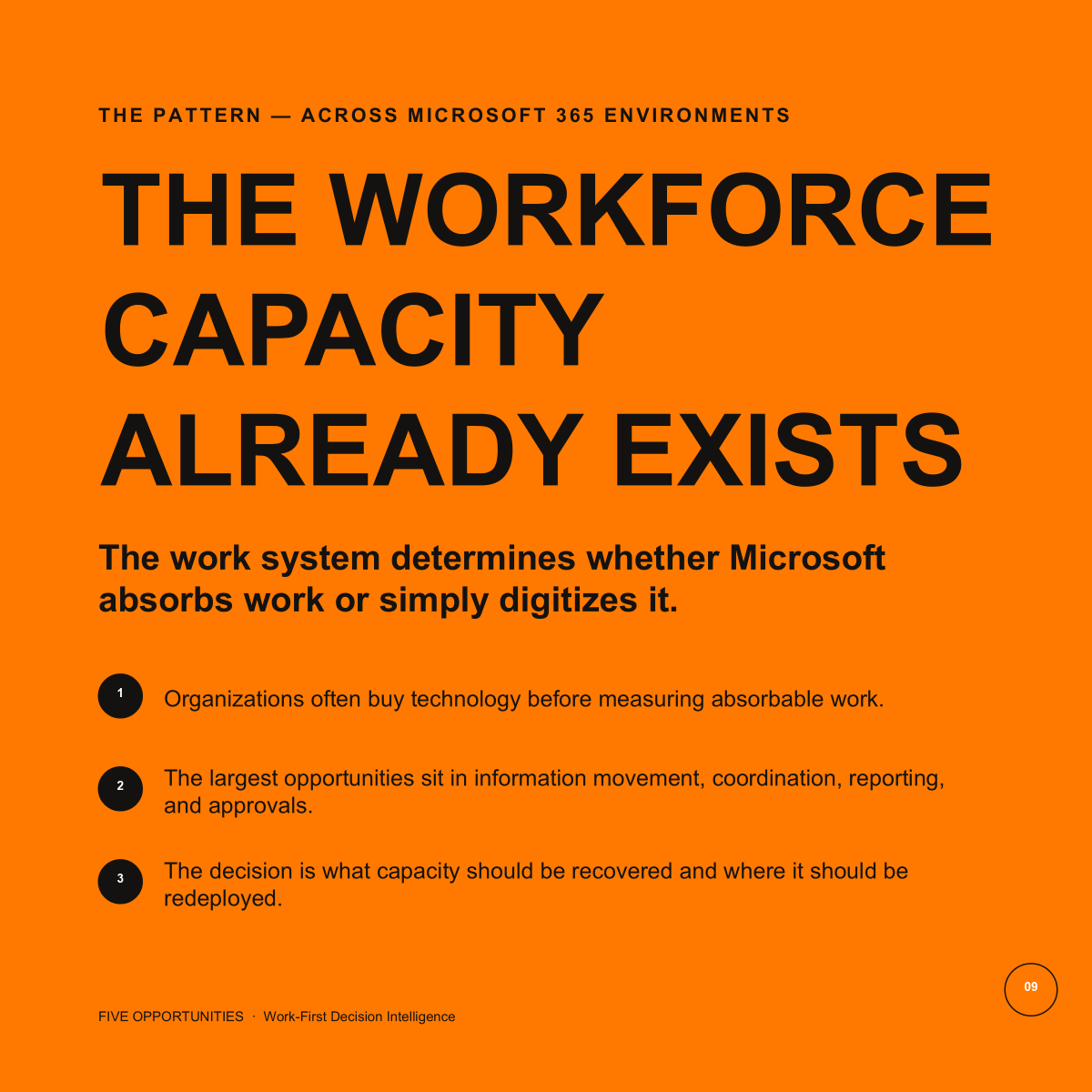
Organizations frequently invest in technology before measuring absorbable work.
The greatest opportunities often exist in:
- Information movement
- Coordination labor
- Approval activity
- Reporting demand
- Documentation effort
- Status collection
- Information retrieval
These activities are rarely viewed as strategic.
Yet together they can consume enormous amounts of organizational capacity.
The opportunity is not simply to automate work.
The opportunity is to understand why the work exists in the first place.
That is where Work-First Decision Intelligence begins.
And that may be where the next generation of Microsoft 365 value creation will be found.
Every vendor optimizes a process a company already runs. WFDI is the only lens that measures how much of their workforce demand is manufactured by the interaction of those processes and tells them how much they can absorb before spending another dollar on labor or software.
What Microsoft 365 Hidden Workforce Capacity Could Your Organization Recover?
The workforce capacity your organization needs may already exist hiding inside your Microsoft 365 environment.
The first step is understanding where work is being manufactured and how much can be absorbed before adding more labor, cutting jobs or buying more software.